Last Orders on the Clyde: The Vanished Pubs Where Working Men Shaped a River's Destiny
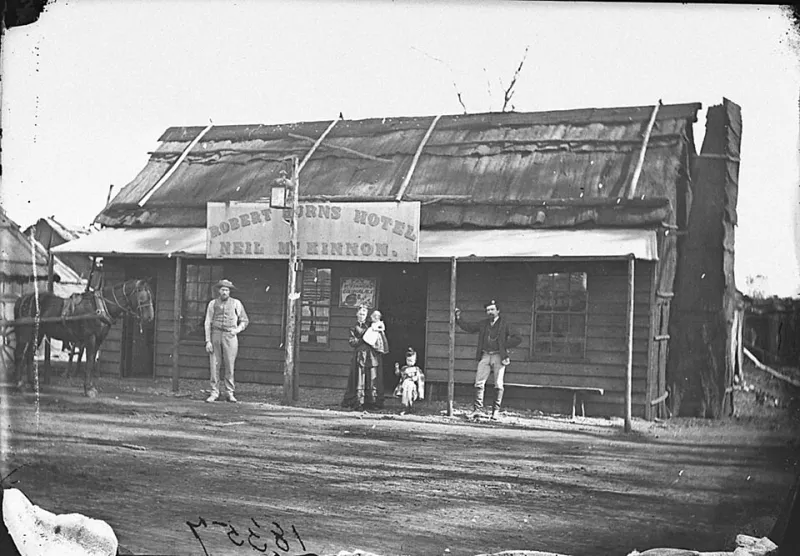
Photo: American and Australasian Photographic Company, Public domain, via Wikimedia Commons
There is a particular kind of silence that settles over a demolished building. Not the silence of emptiness, but the silence of erasure—the absence of everything that once happened within its walls. Along the Clyde's waterfront, that silence has fallen over dozens of public houses that once served as the beating social heart of Clydeside's industrial communities. Tap rooms and snugs, sawdust floors and engraved gantries: these were not merely places to drink. They were, in every meaningful sense, the informal institutions of a working-class world.
To walk the Clyde's banks today is to move through a landscape of ghosts. Where glass and steel now gleam, there were once establishments like The Anchor Bar in Govan, The Shipwright's Arms near Whiteinch, and the long-demolished Boilermakers' Rest that once stood within sight of the John Brown yard at Clydebank. Their names alone speak to the world they served—a world of rivets and furnaces, of men who spent their days in deafening noise and their evenings seeking a few hours of warmth, conversation, and release.
The Pub as Parallel Institution
It would be a mistake to view these establishments purely through the lens of leisure. Historians of working-class Scotland have increasingly recognised that the Clydeside public house occupied a role that was simultaneously social, political, and archival. In an era when many workers lacked access to meeting rooms, legal counsel, or formal civic space, the pub provided all three.
Shop stewards held impromptu assemblies in back rooms. Delegates returning from Glasgow Trades Council meetings would debrief at the bar, translating formal resolutions into plain language for men who had spent the day on the shop floor. Disputes between gangs of riveters and platers—the kind of demarcation arguments that could bring a yard to a standstill—were frequently negotiated, and occasionally resolved, over a round of heavy.
Margaret Docherty, whose grandfather worked as a plater at Fairfield's in Govan throughout the 1940s and 1950s, recalls the stories passed down through her family. 'He always said the real decisions were made in The Graving Dock,' she explains, referring to a Govan pub that closed in the early 1980s. 'The union meeting was the formality. What happened in the pub beforehand was where men actually made up their minds.'
This informal deliberative function was not incidental. It was structural. The pub offered something the formal meeting could not: the freedom to speak candidly, without minutes being taken or management informers present. In this sense, the lost pubs of the Clyde were as much a part of Clydeside's labour movement as the yards themselves.
What Redevelopment Took Away
The closures did not happen all at once. Some establishments were lost during the broad contraction of the shipbuilding industry in the 1960s and 1970s, their customer base simply evaporating as the yards fell silent. Others survived into the 1980s and 1990s, only to be swept away by the regeneration schemes that transformed the waterfront from a working industrial landscape into something more amenable to leisure and property development.
The irony is not lost on those who remember. Communities that had already endured the loss of their livelihoods now watched as the spaces that had sustained their social fabric were replaced by wine bars, luxury flats, and visitor attractions—many of them, in a further twist, celebrating the very industrial heritage whose human carriers had been displaced.
John Mclaughlin, a retired electrician whose family has lived in Govan for four generations, is measured but direct on the subject. 'The heritage trails will show you the cranes and the slipways,' he says. 'They won't show you where the men went after their shift. Those places are gone, and nobody put a plaque on any of them.'
His observation points to a genuine gap in how Clyde heritage has been memorialised. The physical infrastructure of shipbuilding—the docks, the engine shops, the drawing offices—has attracted considerable scholarly and curatorial attention. The social infrastructure has received far less.
Survivors and Custodians
Not every establishment has been lost. A handful of pubs in Govan, Partick, and Dumbarton retain something of their original character, serving communities that have changed enormously but not entirely forgotten their origins. These surviving establishments are, in their own quiet way, living archives.
The Brechin Bar on Govan Road is among the most frequently cited. Its interior, largely unchanged since the mid-twentieth century, has become something of a pilgrimage site for those with family connections to the local yards. Photographs of launches, framed copies of yard newsletters, and hand-written lists of local men who served in the merchant marine during the Second World War line its walls. The pub has, almost by default, become a community museum—one that happens to serve lager.
Elsewhere, oral history projects have begun to capture what bricks and mortar can no longer hold. The Govan Oral History Project, along with various community heritage initiatives supported by bodies including the Heritage Lottery Fund, has gathered testimonies from former regulars and licensees, preserving accounts of conversations, arguments, celebrations, and wakes that unfolded in establishments now reduced to memory.
The Conversations That History Forgot
What strikes any researcher engaging with this material is not simply the historical significance of what was discussed in these spaces, but the texture of everyday life they preserve. Alongside accounts of union strategy and pay disputes, there are stories of men singing together after a launch, of collections taken up for families who had lost a breadwinner to an industrial accident, of the particular rituals—the order of rounds, the unspoken seating arrangements, the etiquette of the bar—that gave these communities their internal coherence.
Isobel Cairns, whose father worked at the Yarrow yard and drank at a pub she prefers not to name—'it's flats now, anyway'—describes the establishment as 'the place where my dad was himself. At home he was quiet. In there, apparently, he talked.' That capacity to enable expression—to give men who spent their days in conditions of physical and hierarchical constraint a space in which to speak freely—may be the most significant and least commemorated function these pubs performed.
Towards a Fuller Account
The recovery of this history is not merely an act of nostalgia. It is an act of historical justice. The Clyde's story has too often been told through the lens of industry, engineering, and enterprise—through the ships that were built, the men who designed them, and the commercial networks that sustained the yards. The social world that made all of that possible, and that bore the greatest cost when it collapsed, deserves equal attention.
As heritage tourism along the Clyde continues to develop, there is a compelling case for ensuring that the human geography of the waterfront—its pubs, its corner shops, its tenement closes—is accorded the same seriousness as its cranes and dry docks. The river's story was not written only in steel. It was written, too, in conversation, in argument, in solidarity, and in the particular kind of community that forms when people share not just a workplace but a way of life.
Last orders, on the Clyde, were called long ago in many of these establishments. But the history they contain has not yet been fully drunk in.