Names in the Ledger: The Forgotten Clydeside Workers Whose Stories Are Finally Coming to Light
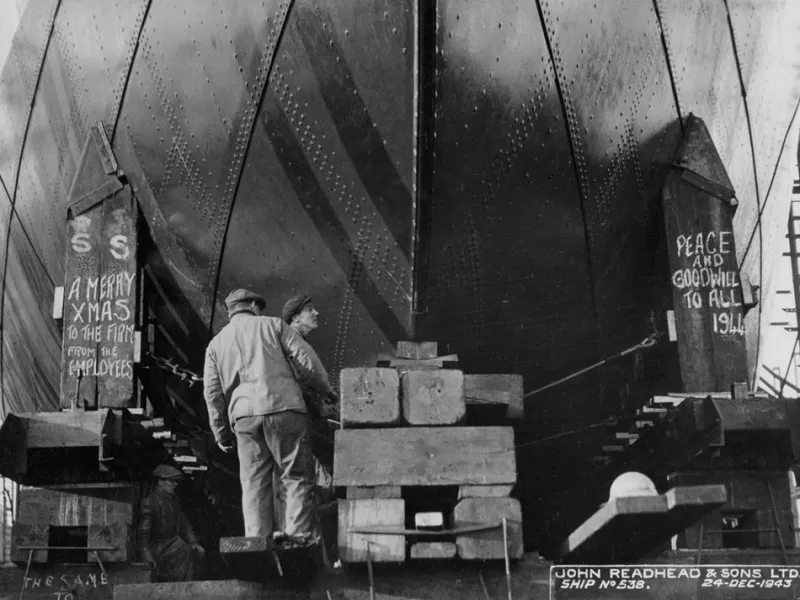
Photo: Tyne & Wear Archives & Museums, No restrictions, via Wikimedia Commons
In a manila envelope donated to a Glasgow archive in 1994 by the family of a retired shipwright from Partick, there is a letter dated March 1941. It is written in a careful, slightly formal hand, addressed from a lodging house in Clydebank to a sister living in Ayrshire. The author describes, with a restraint that speaks volumes, the aftermath of the Clydebank Blitz — the two nights of German bombing in March of that year that killed over five hundred people and rendered tens of thousands homeless. He notes that the yard has not stopped working. He asks after her children. He signs off with his nickname, Tam, and a small pencilled cross.
The letter survived because someone thought it worth keeping. For a very long time, documents like it were the exception. The great industrial story of the Clyde was recorded in contracts, in launch programmes, in the technical drawings that filled the mould lofts of Govan and Clydebank. The human beings who carried out the work — the riveters, caulkers, platers, engineers, crane operators, and office clerks — existed in the margins of that record, if they appeared at all.
That is beginning to change.
What the Archives Contain
The Mitchell Library in Glasgow, one of the largest public reference libraries in Europe, holds one of the most significant collections of Clyde shipbuilding records in existence. Among its holdings are employment ledgers from several of the major yards, technical drawings, company correspondence, wage books, and photographic collections running to many thousands of images. Until relatively recently, much of this material was accessible only to those who could visit in person and navigate paper-based finding aids. Digitisation projects, accelerated in part by funding secured through heritage and cultural grants, have now made substantial portions of the collection searchable online.
The implications for family historians are considerable. Wage books, in particular, offer a level of individual detail that can be startling. A researcher tracing a great-grandfather who worked at Fairfield's in the 1920s might find not only his name and trade classification but also his weekly earnings, his attendance record, and in some cases his home address. Cross-referenced with census returns and civil registration records held by the National Records of Scotland, these entries can anchor a family story in a specific place and time with remarkable precision.
The University of Glasgow's Archive Services holds complementary collections, including the records of the Clyde Navigation Trust and a range of business archives from firms whose operations were closely tied to the river. Researchers with an interest in the management and commercial history of the yards will find these holdings particularly rewarding, though they also contain personnel files and correspondence that illuminate individual lives in unexpected ways.
Oral History and the Living Record
Written records, however meticulous, cannot capture everything. The culture of the Clyde yards — the informal hierarchies, the black humour, the extraordinary skills passed from journeyman to apprentice across generations, the particular solidarity of men working in dangerous conditions for wages that required careful management — survived for decades primarily in the memories of those who had lived it.
The Scottish Oral History Centre, based at the University of Strathclyde, has been collecting recorded testimonies from former shipyard workers and their families since the 1980s. The collection now runs to hundreds of hours of recorded material, and a growing proportion of it has been transcribed and made available for remote access. Listening to these recordings is a qualitatively different experience from reading a wage ledger. The voices carry inflection, humour, and grief in ways that no document can replicate.
One recurring theme in the testimonies is the complexity of working-class professional identity along the Clyde. Shipbuilding was a highly stratified industry: the distinctions between trades were fiercely maintained, and a man's classification — whether he was a riveter, a plater, a joiner, or a painter — defined not only his earnings but his standing within the yard's social world. Several testimonies describe the pride that accompanied apprenticeship and the sense of belonging that came with full trade qualification. Others speak of the anxiety that accompanied the industry's long decline, and the particular anguish of watching yards that had employed three generations of a family fall silent.
Women feature in the oral histories in ways that the written record often obscures. While the yards themselves were overwhelmingly male environments, women's labour was integral to the broader shipbuilding economy — in the administrative offices, in the canteens, in the domestic sphere that sustained the workforce, and, during wartime, on the shop floor itself. Several testimonies from women who worked in Clyde yards during the Second World War describe the experience with a mixture of pride and ambivalence; the work was valued, but its acknowledgement was often brief.
Finding Your Own Connection
For visitors to Glasgow with family roots in the West of Scotland, the Clyde shipyards represent one of the most likely points of ancestral connection. At the industry's height, the yards employed tens of thousands of workers drawn from across the Clyde valley and beyond, and the communities that grew up around them — Govan, Partick, Clydebank, Greenock, Port Glasgow — were shaped by the rhythms of the working day in ways that persisted long after the yards themselves had closed.
The Mitchell Library offers a dedicated family history service, and staff there are experienced in guiding researchers through the shipbuilding collections. The library's online catalogue is a useful starting point for anyone wishing to identify relevant holdings before making a visit. The ScotlandsPeople website, operated by the National Records of Scotland, provides access to civil registration records, census returns, and valuation rolls that can help to establish the broader context of a family's life in the shipbuilding communities.
For a more immersive introduction to the subject, the Riverside Museum's permanent collection includes a significant section dedicated to the social history of the Clyde yards, with interpretive displays that contextualise the working lives of those employed there. The museum's programme of temporary exhibitions and public events has in recent years included several projects focused specifically on worker histories, some of which have drawn directly on the digitised archive collections.
Why These Stories Matter
The impulse to recover the individual from beneath the weight of industrial history is not merely sentimental. The Clyde's shipbuilding era produced not only ships but a distinctive working culture — technically sophisticated, socially cohesive, and capable of extraordinary collective achievement — whose influence extended far beyond the riverbank. The political and trade union traditions that emerged from the Clyde yards shaped Scottish and British public life throughout the twentieth century. The engineering knowledge developed there contributed to fields as varied as aerospace, civil construction, and offshore energy.
To understand where the river is going, it helps to understand who built it. The names in the ledgers — Tam and his colleagues, the riveters and the clerks and the women who worked the canteen — are not footnotes to the story of the Clyde. They are the story.
The archives are open. The voices are waiting to be heard.