Behind the Close Door: How Clydeside's Tenement Neighbourhoods Forged a Working-Class World
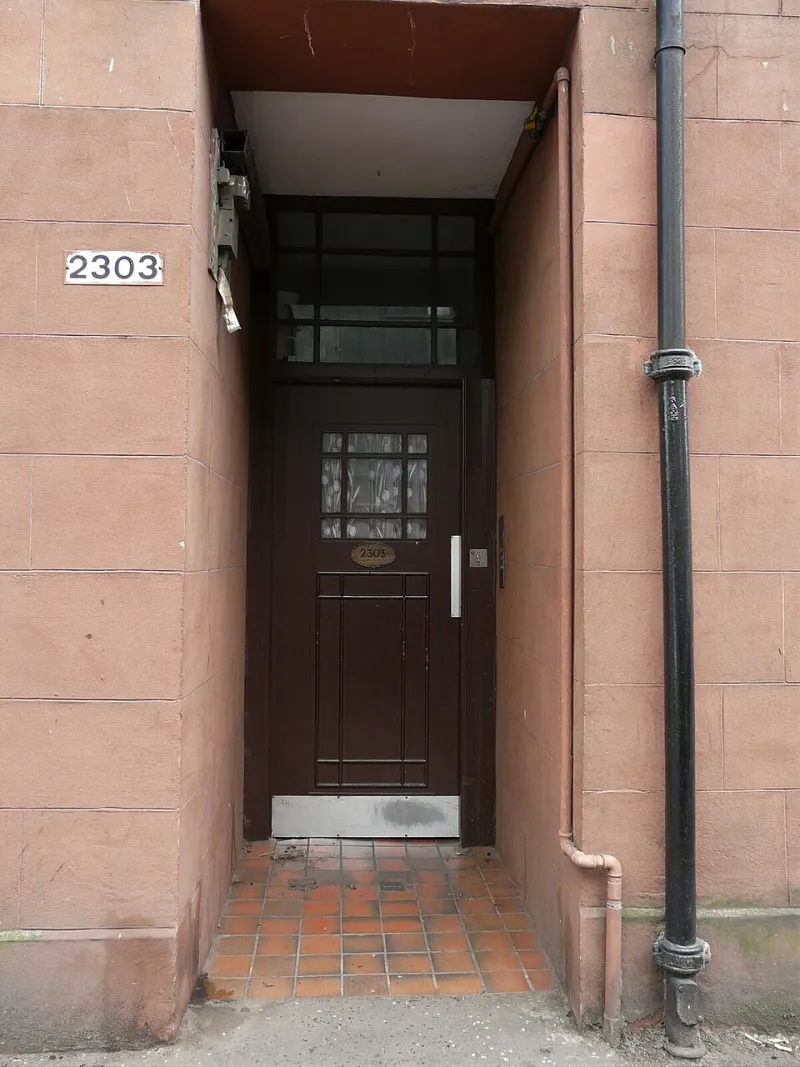
Photo: Richard Sutcliffe , CC BY-SA 2.0, via Wikimedia Commons
The Other Architecture of the Clyde
Visitors to the Clyde waterfront are well served by accounts of its industrial infrastructure. The history of the great yards — their technical innovations, their famous launches, their eventual decline — has been told and retold with considerable care. What receives rather less attention is the domestic architecture that surrounded and sustained that industry: the dense grid of sandstone tenements, back courts, and shared closes where the shipyard workers, their families, and their neighbours actually lived.
To walk through Govan or Partick or the lower reaches of Greenock with any attention to the surviving built fabric is to encounter a social history that the shipyard records alone cannot supply. These streets were not merely residential overflow from the yards. They were, in the fullest sense, the engine room of the industrial Clyde — the places where labour was reproduced, where community was negotiated, and where the pressures of industrial capitalism were experienced at the most intimate scale.
The Close as a Social Institution
The word 'close' refers, in Scottish usage, to the shared entrance passage of a tenement building and, by extension, to the community of households that used it. In the industrial districts of Clydeside, a close might serve anywhere from four to twelve families, stacked across two or three storeys, sharing a single stair, a communal back court, and — in the earlier decades of the industrial period — outdoor privies that served the entire building.
The physical conditions were, by any contemporary standard, severe. Municipal surveys conducted in Glasgow during the 1930s found significant proportions of tenement housing classed as overcrowded under even the modest thresholds then in use. Single-end dwellings — consisting of one room — were still common, and families of five or six persons occupying a two-room flat were unremarkable. Ventilation was poor, damp was endemic, and the proximity of heavy industry meant that soot and chemical residue were permanent features of the domestic environment.
And yet the oral histories collected by community archivists, university researchers, and organisations such as the Govan Reminiscence Group over the past four decades tell a more complicated story than one of simple deprivation. What emerges from these testimonies, again and again, is a picture of extraordinary social density — of lives lived in close and constant proximity to neighbours, in a culture shaped by that proximity in ways that were frequently sustaining rather than merely burdensome.
'You knew everybody,' recalls Margaret Docherty, born in 1938 in a Govan tenement whose close she shared with seven other households. Her account, recorded as part of a community oral history project in the 1990s and held in the Mitchell Library's Glasgow collection, continues: 'You knew their business and they knew yours. That wasn't always comfortable. But if something went wrong — if your man was laid off, or a child was ill — there was always somebody. The close looked after its own.'
Diaries from the Tenement
Written sources from within the tenement communities are rarer than oral testimony, but they exist, and they reward careful reading. The Mitchell Library holds several volumes of diary entries and letters produced by working-class Clydeside residents during the interwar period, a number of which have been transcribed and made available to researchers in recent years.
One such document, kept by a woman identified in the catalogue only as 'Mrs A.M., Partick, 1927–1934,' records the texture of close life with an observational precision that no official survey could replicate. Her entries move between the mundane and the catastrophic with the matter-of-fact tone of someone accustomed to both: a neighbour's child recovering from scarlet fever; a dispute over the cleaning rota for the shared stair; the week her husband's hours at the yard were cut and she began taking in washing to compensate; the particular quality of the light in the back court on a summer evening when the children were playing and the noise of the river was, for once, inaudible.
What the diary communicates above all is the degree to which close life required constant negotiation — of shared resources, shared space, and shared vulnerability. The stair had to be cleaned on a rota; the back court had to be managed; disputes had to be resolved without the intervention of authorities who were, in any case, largely absent from these communities except as agents of enforcement. The social skills demanded by tenement living were considerable, and they were not incidental to the broader culture of Clydeside's working class.
Resistance and Solidarity
The connection between the tenement close and organised resistance to industrial capitalism is well established in Scottish social history. The Rent Strikes of 1915 — in which Clydeside women, many of them wives of shipyard workers deployed in the war effort, organised against rent increases imposed by private landlords — originated precisely in the networks of mutual knowledge and trust that close life had built over decades.
Mary Barbour, the most prominent figure in that movement, drew directly on the social infrastructure of the Govan tenements. The speed with which information about impending evictions could be communicated, and the rapidity with which neighbours could mobilise to prevent sheriff's officers from carrying out their instructions, depended on relationships that had been formed at the close door and on the shared stair. The strikes were a political event, but they were made possible by a social architecture that is too rarely acknowledged in accounts of Clydeside radicalism.
Architects and social historians have begun, in recent years, to revisit these spaces with fresh attention. Dr Fiona McAllister, whose research at the University of Strathclyde has focused on the relationship between tenement design and community formation, argues that the close was 'a deliberately ambiguous space — neither fully public nor fully private — that created conditions for a particular kind of sociality that has no precise equivalent in later housing forms.'
What Survives, and Where to Find It
A substantial portion of Clydeside's tenement stock survives, though it has been substantially altered by twentieth-century improvement schemes, demolition programmes, and more recent renovation. The Conservation Area designations covering parts of Govan, Partick, and the West End of Glasgow protect much of what remains, and several community organisations actively work to document and interpret the social history of these buildings.
The Govan Cross area offers one of the most coherent surviving examples of industrial-era tenement streetscape accessible to visitors. The Pearce Institute, itself a product of industrial philanthropy directed at the tenement community, provides context for the surrounding streets. In Greenock, the town's local heritage centre maintains an archive of photographic and documentary material relating to tenement life in the lower Clyde communities.
For those wishing to engage more directly with the oral history record, the Voices of the Clyde project — a collaboration between several Scottish universities and local archive services — has made a substantial body of recorded testimony available online, including material relating specifically to domestic and neighbourhood life in the industrial period.
The Heritage That Lives in the Stairwell
The Clyde's industrial heritage is, rightly, a matter of considerable civic pride. But pride in the ships should not obscure the lives of those who built them, nor the social world that made such labour possible. The tenement closes of Govan, Partick, and Greenock were not peripheral to the industrial story — they were its foundation.
To understand the Clyde fully is to stand in a sandstone close on a damp Scottish morning, look up at the worn steps of a shared stair, and recognise that the history written here is every bit as significant as anything recorded in a launch register or an engineering specification. The river tells many stories. Some of them begin at the close door.