Rivets to Routers: The Rebirth of Clydeside's Shipyard Lands as Innovation Quarters
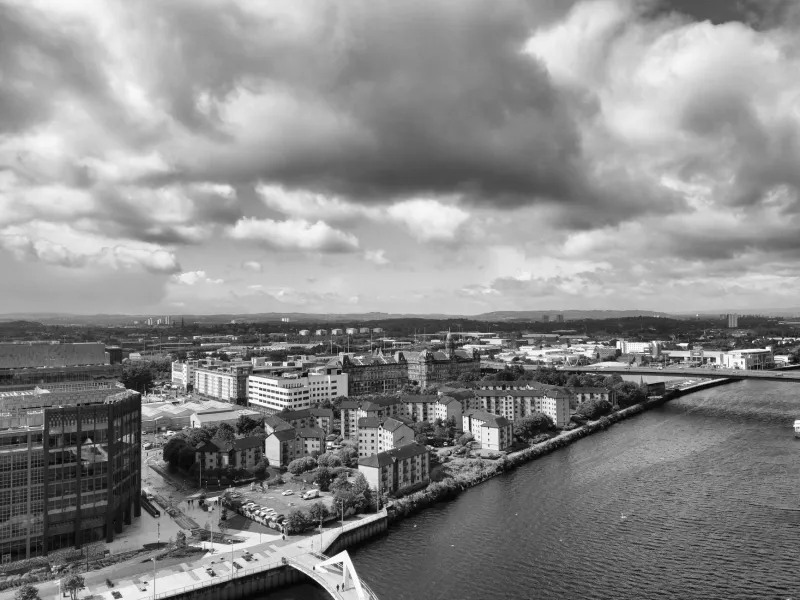
There is something quietly disorienting about sitting in a glass-walled meeting room, laptop open, coffee cooling, while outside the window a dry dock stretches into the grey Clyde sky. The concrete lip of the dock, worn smooth by decades of industrial use, now serves as a terrace where young developers take their lunch breaks. The cranes are gone. The noise is different — keyboards rather than caulking irons, the hum of server fans rather than pneumatic riveters. Yet the bones of the place remain, and they are unmistakably Clydeside.
Across several former shipyard sites between Govan and Greenock, a transformation has been quietly gathering pace for the better part of two decades. What were once the most productive stretches of industrial waterfront in the world are becoming something new: clusters of technology firms, creative agencies, social enterprises, and digital start-ups, drawn not merely by affordable floorspace but by a sense of place that newer business parks simply cannot manufacture.
The Lay of the Land
Understanding why these sites are attracting modern occupants requires an appreciation of what they actually are, physically. Shipyards were not simply large sheds. They were complex industrial ecosystems — vast, flat plots of land directly adjacent to deep navigable water, served by heavy-gauge rail connections and surrounded by dense residential communities whose entire social fabric was organised around the rhythms of the yard. When the yards closed, what remained was an unusual combination: significant acreage, often with listed structures or scheduled ancient monument status, embedded within established urban neighbourhoods and connected to the city centre by the river itself.
For urban planners, this presented both an opportunity and a considerable challenge. The sites were too large to redevelop piecemeal, too historically significant to clear entirely, and too embedded in community identity to hand over to generic commercial developers without consequence.
"You can't treat these places like a blank canvas," explains one Glasgow-based urban regeneration consultant who has worked on several Clyde waterfront projects. "The physical infrastructure carries memory. The workers who built ships here, their children and grandchildren still live in the surrounding streets. Any development that ignores that relationship is going to face resistance — and rightly so."
New Occupants, Old Walls
At a refurbished engine shed on the south bank, a software development company employing around forty people occupies what was once a maintenance facility for heavy lifting equipment. The original ironwork columns remain, repainted but structurally unchanged. The firm's founder, who grew up in Govan, is candid about what drew him back to this particular postcode after years working in Edinburgh and London.
"There's a directness about this place that you don't find in a purpose-built office park," he says. "People who come to work here understand something about making things, about craft, even if what they're making is software. I think it changes how they approach problems."
This sentiment — that the industrial character of a space can exert a subtle but genuine influence on the culture of its occupants — surfaces repeatedly in conversations with businesses operating along the regenerated waterfront. Whether it reflects a genuine psychological phenomenon or a convenient narrative for marketing purposes is a question worth holding open. But it is striking how consistently it is articulated.
A digital media agency based in a converted drawing office at another former yard site employs a similar vocabulary. The drawing office, where naval architects once produced detailed plans for ocean-going vessels, now houses graphic designers and video editors. The original plan chests — enormous flat-file cabinets built to accommodate full-scale drawings — have been retained as a centrepiece of the studio. "We use them for client presentations," the studio director notes, with a smile that suggests she is aware of the symbolism.
Tensions Beneath the Surface
Not everyone views the transformation with uncomplicated enthusiasm. For many long-term residents of communities like Govan, Scotstoun, and Port Glasgow, the arrival of technology businesses and creative industries represents a change in economic register that feels, at best, tangential to their own circumstances.
"My father worked at Fairfield's. My uncle was at John Brown's," says a retired community worker who has lived in Govan for most of her life. "When they talk about regeneration, I always ask: regeneration for whom? The jobs that are coming back don't look anything like the jobs that went. And the people who are getting them don't always come from here."
This tension — between the economic logic of attracting high-value, knowledge-sector businesses and the social obligation to the communities most affected by deindustrialisation — is one that planners and developers acknowledge, even if they do not always resolve it satisfactorily. Several of the larger regeneration projects along the Clyde have incorporated community benefit clauses requiring occupants to offer apprenticeships, local procurement commitments, or engagement with schools and community groups. How rigorously these commitments are honoured in practice varies considerably.
There are also more immediate concerns about the physical heritage of the sites themselves. Listed structures require expensive maintenance. The cost of adapting Victorian-era industrial buildings to modern building regulations — in terms of insulation, accessibility, and fire safety — can be prohibitive for smaller occupants. Several heritage advocates worry that commercial pressure will, over time, erode the very character that makes these sites distinctive.
"Once you start value-engineering the history out of a building, you end up with something that could be anywhere," warns an architectural historian who has documented several Clyde shipyard structures. "The ironwork, the brick, the spatial grammar of these places — that's not decoration. That's the argument for being here at all."
What the River Remembers
Walking along the waterfront on a clear afternoon, it is possible to hold both versions of the Clyde simultaneously in view. A group of young people emerges from a co-working space housed in a former pattern store, phones in hand, talking animatedly about a pitch they are preparing. Fifty metres away, a heritage interpretation panel describes the launch of a cargo vessel from the same spot in 1923, illustrated with a photograph of thousands of workers gathered on the slipway.
The river does not adjudicate between these two moments. It simply continues, indifferent and patient, carrying both stories in equal measure.
What the best of the Clydeside regeneration projects seem to understand — and what distinguishes them from more generic waterfront developments elsewhere in Britain — is that the industrial past is not a liability to be managed or a backdrop to be commodified, but a genuine asset: a source of identity, of narrative, and of belonging that the knowledge economy, for all its restlessness, increasingly struggles to provide.
Whether the start-ups currently occupying these storied sites will still be here in twenty years, or whether they will have moved on in search of cheaper space or better connectivity, is an open question. The buildings, with any luck, will remain. And the river, as ever, will remember what happened here — even when those who pass through have long since forgotten.